Organizing Rain Gear for a Warm, Humid Day in the Woods
During wet weather, many piece systems become a gear problem as well as keeping a person dry. A waterproof jacket can trap heat. Loosely rolled layers in a pack can be noisy, slow to find, unpleasant to wear and get wet. Best to separate an emergency layer from a person's active wear and allow damp items to dry out of the rest of the load rather than letting them become wet as well and contaminate the dry items.
Start with the Forecast You Can Actually Use
In determining whether to bring rain gear, consider the same factors that you would use in determining whether to go on a hunt in the first place: the weather. Focus on the weather forecast for the time you plan to be out hunting, and look for patterns that will bring rain, as well as the length of time that the rain is expected to last.
Consider more than just the probability of rain when choosing layers. Warm temperatures, high humidity, wind and long periods of walking all influence the amount of ventilation needed. Someone sitting for hours in a blind from a short walk may need a very different outer layer to a person moving through thick cover, checking on habitat projects, and visiting several sites over the course of the day.
The really critical things that need to stay dry are typically those that you would not want to be ruined by accident (such as your summer down-filled insulation), critical survival items (like your fire-starting means), permits, food, medications, and electronics. Then list them in the order in which you would wish them to be packed and go from there.
Choose the Outer Layer for the Work
We prefer lightweight water repellent or waterproof-breathable outer layers (shells) that provide good ventilation. Typically these jackets can be worn as a wind layer, to cover a mid-layer, or as a pack cover when the weather clears. Choose a hood that provides good visibility, make sure the cuffs can be cinched up without too much effort and have plenty of accessible pockets to store items while wearing a pack or harness.
A poncho will also cover the upper part of your body (and often part of your pack) and help to increase air flow over your body whilst stationary in wet, humid weather. However, ponchos are loose pieces of fabric that can catch on brambles, be flapped about in the wind and be a nuisance when shooting from a rest or climbing. Also, they do not offer as much lower leg protection as a good quality outer layer.
These will be necessary for particularly wet routes with much grass, or briars, or even wet vegetation. You might wear them for a wet approach but would probably find them too hot for a long wait in a warm, sheltered spot. So, yes, take them. But only take them.
Build a Two-Speed Clothing System
There are two states for clothing in wet weather: travel and waiting. While traveling through wet terrain such as through grassy, wet, or muddy fields, in brushy or thorny woods, etc., you need clothing that will provide the most ventilation and flexibility to ease your movement. Once at your waiting position, in a tree stand, blind, ground blind, etc., you can don much warmer clothing. So your clothing must provide two different types of wear.
Organize your clothing around the two main scenarios of your hunting trip: travel (approach) and waiting (at your stand). For the approach, you will want to be able to wear items that allow good ventilation and help to allow for lots of movement. Once you have reached your stand, you will need to cover up more in order to keep rain and wind off. Organize your clothing so that for travel you wear less clothing and for waiting you can add layers as needed.
Cotton is worst. Most people are familiar with this statement. It simply means that when wet with rain or snow (for winter hunters), it will not dry quickly and will therefore be cold against your skin. Its existence in your clothing system, against your skin, in cold, wet conditions for extended periods of time, is therefore poor.
Give Every Piece a Reachable Place
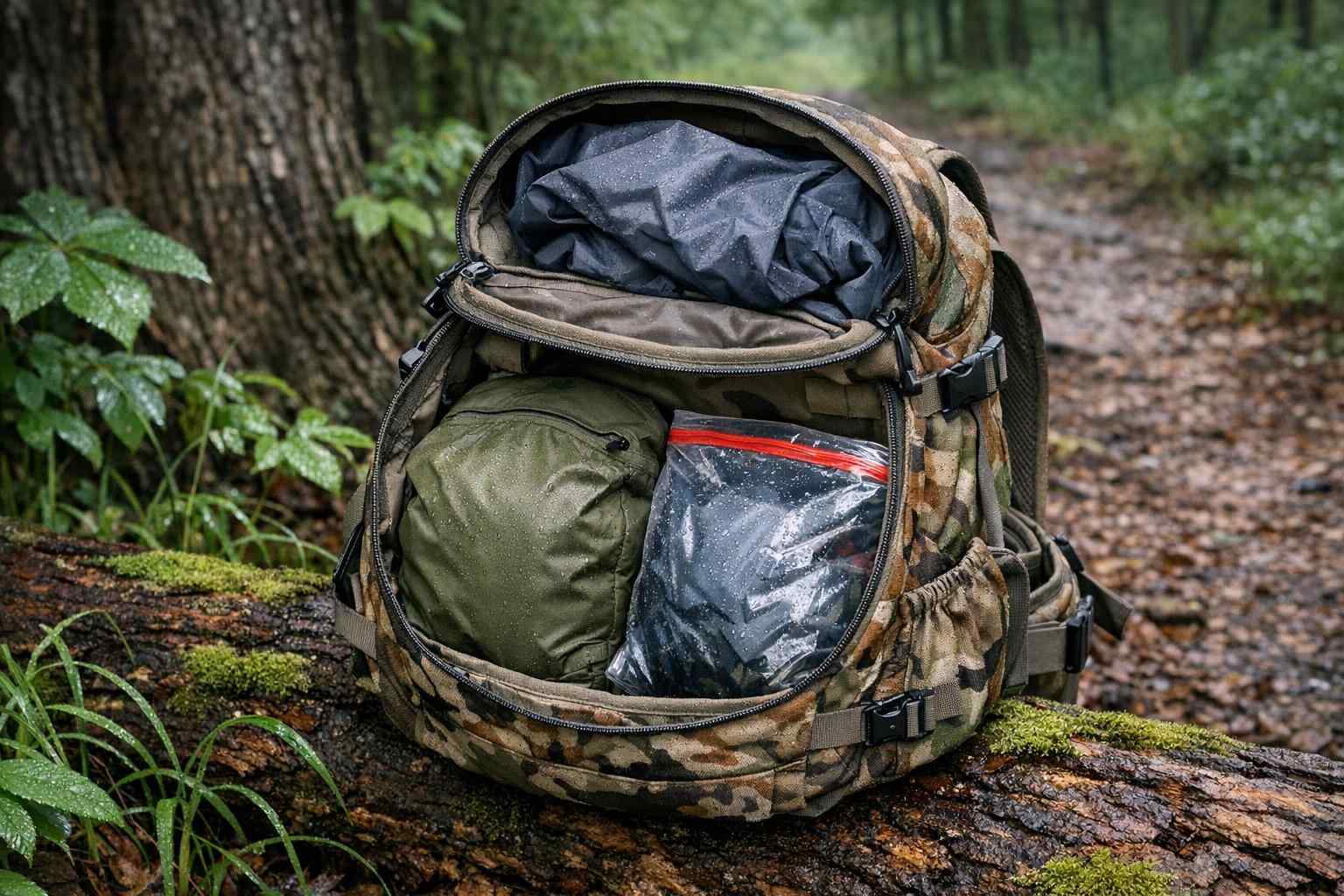
Pack your outer rain layer at the top of your pack so that it is the first thing to hand when you arrive at your camp. This will help prevent it from getting lost deep within your main compartment. Your pack's side pockets are also a good location for this item. If you're bringing rain pants then pack them in the same location as your outer shell layer. A small waterproof bag can be used to store wet items such as your socks, or items that cannot get wet such as electronics, first aid items, etc. However this bag should not be relied upon to keep your entire pack dry in wet weather.
Assign each layer of clothing to a separate bag (e.g. a dry clothing bag, an electronics/papers/picnicItems bag, a wet clothing bag to collect your clothes as they get wet). Make sure that all of your bags are transparent or a highly visible color so that you can see what you have stored away in them in the dark.
Before you even put the garment in your pack don't compress the shell garment. You don't know what else you are going to stuff in your main compartment and the last thing you need is your best rain jacket stuck at the bottom of your main compartment. Test reach for the jacket whilst wearing your pack and gloves. Can you easily open the zipper? Can you reach into the pocket(s) to grab something?
Manage Sweat, Condensation and Wet Storage
The water in your rain jacket did not always come from the sky above. A lot of the time it is your own body's sweating that is left in the jacket lining to evaporate slowly after you take it off. Opening up the venting on your jacket when you are moving, rolling up the front of the hood, and removing the jacket when you are stopped for a long time and the weather is stable are all things to consider when trying to manage sweat in your rain gear.
Don't store your wet rain jacket in the same dry bag as your insulating layers – shake off as much water as possible and store it somewhere to dry as soon as possible (like off a hook in a porch). Store your wet gear in a separate wet-item bag (ideally a plastic one) until you can wash or dry it.
Be careful when cleaning your outer layers at home. Even dirt and body oils can reduce the water-repellent finish of a waterproof and breathable membrane. Also, be careful when washing outer layers, as well as when repairing them. Some cleaning solutions and patches can even damage the waterproof coating.
Check the Details That Commonly Fail
Check that the brim of the hood will cover a cap. Test the cuffs down at the wrist. Ensure that the hem won't ride up as you walk. Inspect all the seams, zippers, etc. before the season begins. They're the sorts of things that cause the most frustration when they fail.
Ripstop pack covers for binoculars, rifle, etc. can help protect them from rain but if wind is blowing and pack is open then rain will enter through the gap. When opening pack then need to temporarily re-arrange items to stop rain entering. Sometimes it is easier to keep items in rainproof pocket rather than in pack.
Many people get too focused on trying to find the one "best" waterproof jacket, and in doing so, fail to consider layers and heat. A thin shell is just that, it does not make a good brush or wind layer and should not be relied upon for long periods of time.
Match the Setup to the Day
On short trips we go with a lightweight waterproof outer, pack cover or bag liner, and a small dry sac to carry essentials. Long walks in wet weather with time to sit and hunt involve rain pants, insulated layer(s) protected from the wet, and some thought given to how wet clothing will be stored.lemetry laden with thick vegetation calls for quiet, durable clothing that won't snag or get caught up in branches.
Don't forget to recheck your clothing prior to an outing. The weather may have changed, you may be using a different pack than usual, or even have repaired the shell of your jacket – in which case it may not fit in the same way as before. Keep it simple and quiet enough to use in the field, but with enough distinction so that you can see the purpose of each item.
Rather, manage your sweat, stay warm when traveling slowly, and bring rain gear. A two-layer approach will keep critical items dry and warm while traveling, and cover you in the event of rain. You will find that you are left with less gear in the bottom of your pack to abandon when the woods turn wet.